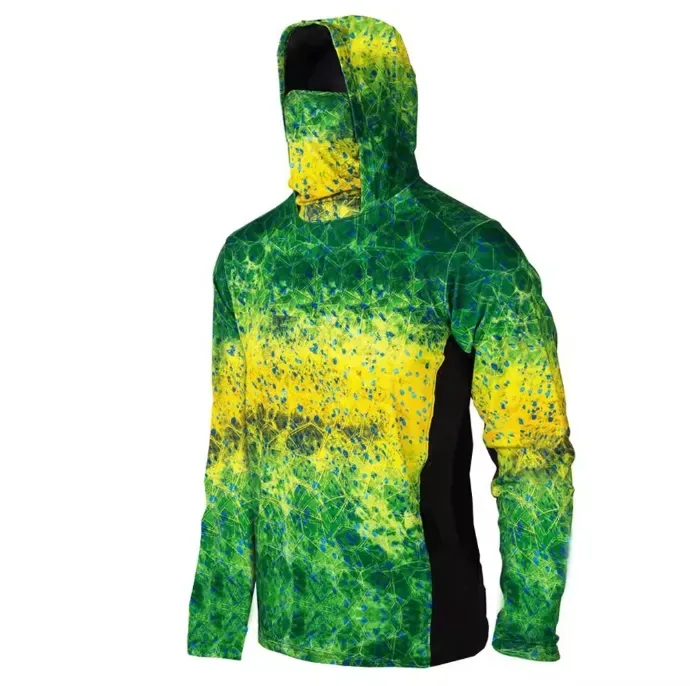
Buyers tend to start with print. Anglers judge with their neck, their wrists and their sunglasses. These are the seven construction points that come up in every sample review we run.
Most fishing is done in a cap. A hood that is cut to sit flat on a bare head will pull tight across the brim and lift the hem at the back. The fix is not a bigger hood — it is a taller crown and a slightly wider opening, so the fabric drapes over the brim instead of fighting it. Ask for a photo of the hood worn over a cap, not on a mannequin.
The mask sits under the hood and over the nose. If the top edge is a straight seam, exhaled air goes straight up the cheeks and into the lenses. A shaped top edge with a small dart, plus a fabric that passes air rather than blocking it, is the difference between a mask people wear and a mask people tuck under their chin after ten minutes.
The sleeve has to cover the back of the hand when the arm is extended on a cast, not when the arm hangs at the side. A thumb loop holds that position without the sleeve riding up on a retrieve. It also means the cuff is not elasticated so tightly that it leaves a mark after six hours.
An overlocked side seam is a ridge. Under a PFD strap, a rod belt or a backpack, a ridge becomes a rub point by mid-afternoon. Flat-lock joins the panels edge to edge with no raised seam. On a tournament shirt worn from 5 a.m., this is not a detail — it is the reason the shirt is comfortable at noon.
Venting placed decoratively across the back panel does little: a PFD covers it. The heat builds under the arms, across the lower back where the body meets the seat, and inside the hood. Panels there do something. Panels on the shoulder blades mostly sell well in photographs.
Two constraints to keep in mind: mesh reduces coverage, and coverage is the reason the shirt exists. Under-arm mesh is the usual compromise — it is rarely in direct sun.
Sublimation dye bonds into polyester. On a dark base, a light print needs a white underlayer or the colour shifts. Get that wrong and a brand's red becomes brick and their white becomes grey. If your artwork has a specific Pantone, ask for a printed swatch on the actual base fabric before the bulk run — not a screen preview.
Hooded shirts often carry a self-fabric collar under the hood. If it is cut too tall it flaps in wind; too low and the hood pulls it up. A short, close collar with a small amount of stretch sits still. It also gives you somewhere to put a woven label that does not scratch.
Ask for a sample and do this in order: wear it with your own cap, put your sunglasses on and breathe hard for a minute, extend both arms as if casting, put a loaded pack on, then look at the side seam in a mirror. Any of those five tests will surface a problem before you commit to 200 pieces.
Samples take 5 days. If something is wrong, we would rather change the pattern before the bulk run than discount a defect afterwards.
Where these seven points land: hooded sun shirt, hooded long sleeve and long sleeve performance. If you already have a sample in hand and want a second opinion, send photographs of the seams.
Yes. Send the cap you wear, or its brim width, and the crown height and opening can be adjusted on the pattern before sampling.
Mesh panels have lower coverage than the body fabric. That is why we keep them under the arm, where direct sun is limited, and leave the shoulders solid.
One new entry every week. RSS if you would rather not check back.
Screen printing has a setup cost that has to be paid before the first shirt. Dye sublimation does not — which is the whole reason a 12-piece order is possible. Here is where the money actually goes at low volume.
Read the note →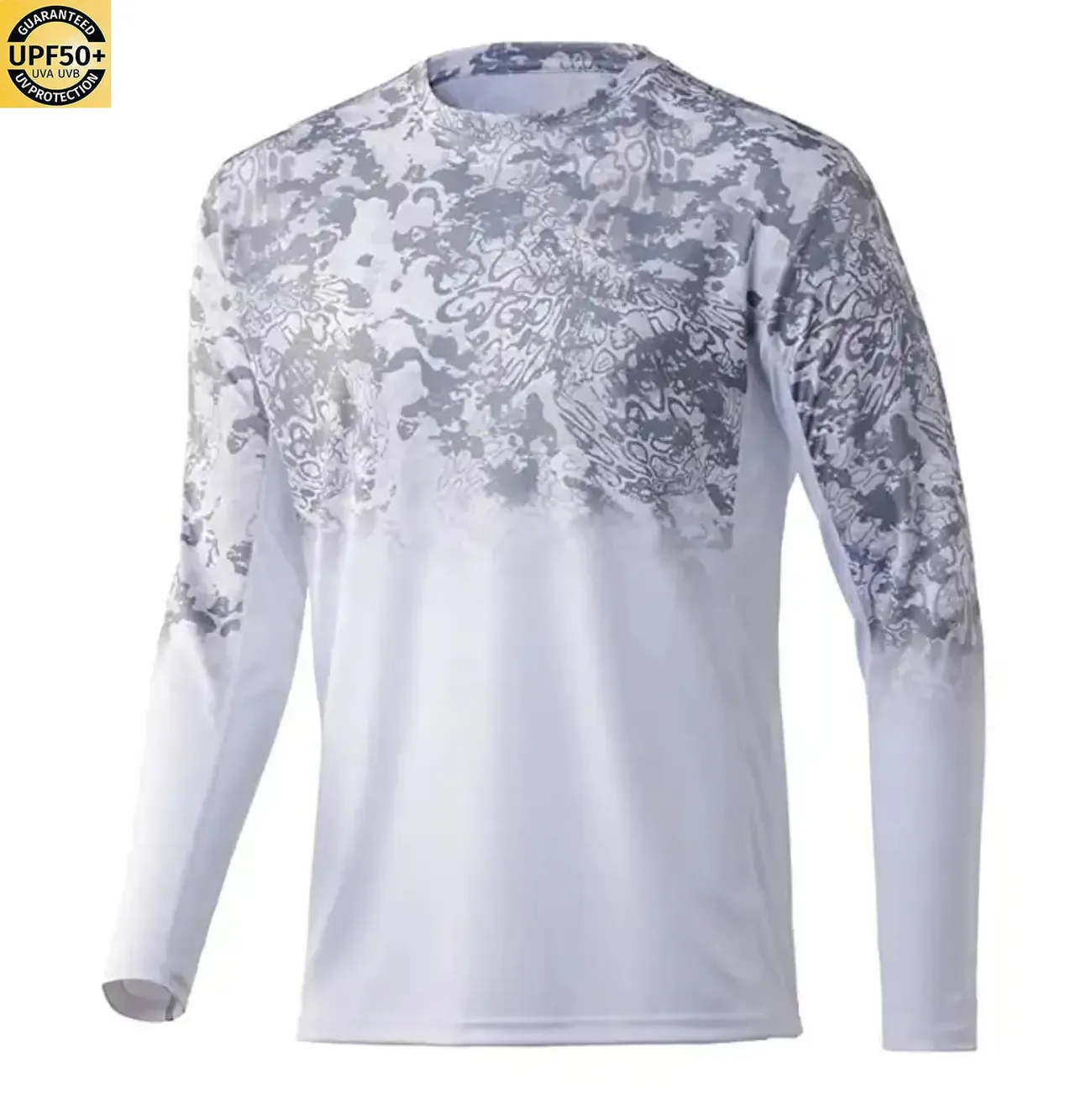
UPF is a ratio, not a feeling. It is measured on fabric, in a lab, under specific conditions — and those conditions are where most claims quietly fall apart. Here is what the number means and what to ask for.
Read the note →Fabric, print coverage, sizes and destination is enough to start.